 Quick Comet
Mobile Apps for Local Service Businesses [2025]
Introduction
Local service businesses across the USA are feeling the squeeze. Customers want the convenience of big-brand apps—one-tap booking, instant notifications, digital payments—but many small businesses are still relying on phone calls, DMs, and paper calendars. At the same time, marketplace platforms and aggregators keep more customer data for themselves, making it harder for local brands to build direct relationships.
Mobile app development for small businesses has matured to the point where local salons, home service companies, coaches, and clinics can launch their own branded apps without enterprise budgets. A well-designed app can centralize bookings, payments, loyalty, and communication, turning casual visitors into repeat customers and giving owners a direct channel to reach their audience.
In this guide, you'll learn:
- Why mobile apps matter for local U.S. service businesses in 2025
- The most effective app types for salons, home services, coaches, clinics, and more
- What features to prioritize so your app actually gets used
- Typical timelines and cost ranges for local business app projects
- How a USA-based agency in Sacramento, California like Quick Comet can design, build, and launch your app faster than you expect
If you want more bookings, stronger loyalty, and a brand experience that feels as polished as national competitors, this article will show exactly how a mobile app can help your local business grow in 2025.
Why Local Service Businesses Need Mobile Apps in 2025
Industry guides on mobile app development for small businesses highlight that customers now expect "always-on" digital access: booking, paying, and getting updates from their phones. For local service businesses, this expectation is increasingly shaping where people go for haircuts, repairs, coaching sessions, or clinic visits.
A dedicated mobile app gives you:
- A direct channel to customers instead of relying on social algorithms or marketplaces
- A faster, more reliable booking and reminder system than manual calls or DMs
- A way to collect and use customer data (with consent) to personalize offers and communication
Some reports on small business app adoption show that owners using apps to manage bookings, loyalty, and communication report better retention and more repeat revenue than those relying only on websites or social media.
High-Impact App Ideas for Local Service Businesses
1. Booking and Scheduling App for Salons, Spas, and Clinics
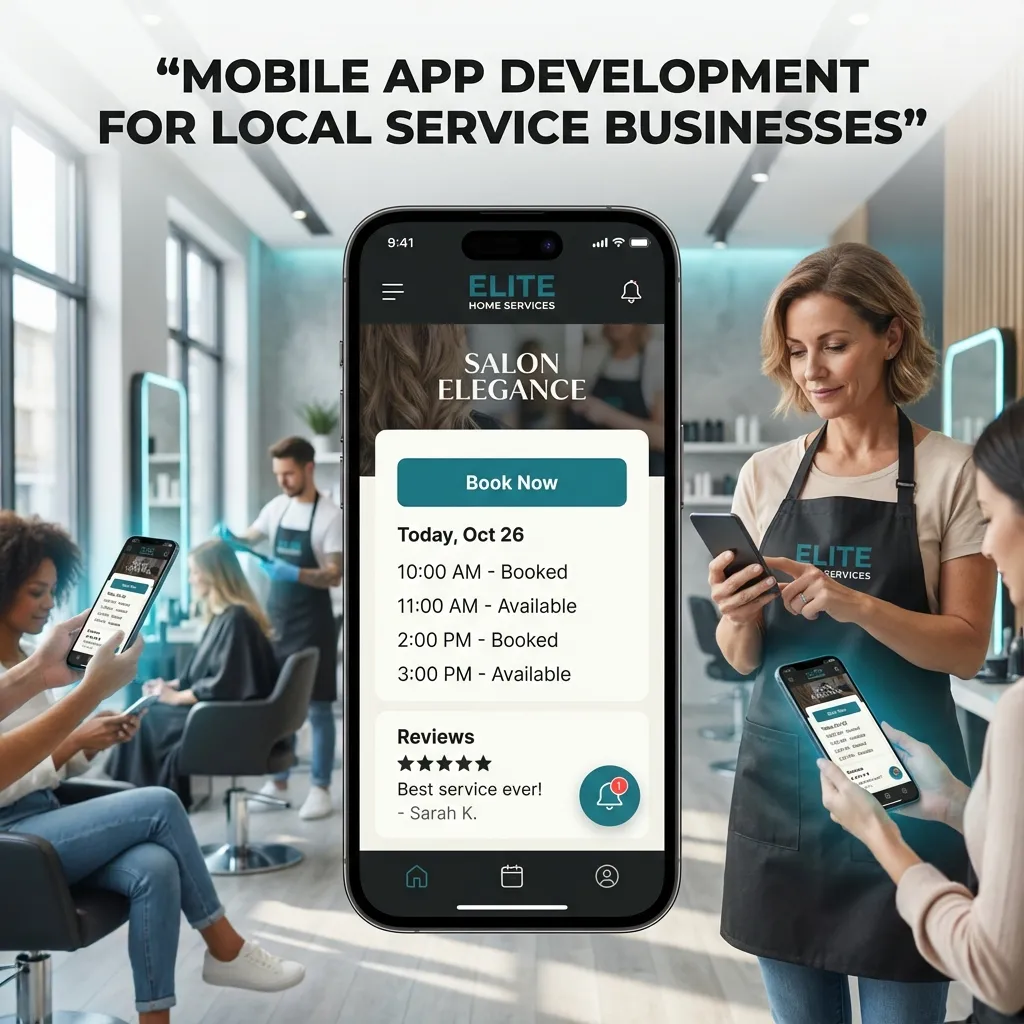
Guides on small business app ideas consistently list appointment apps as one of the top use cases for local service businesses. Instead of juggling calls, DMs, and walk-ins, you centralize everything into a branded app that customers can use anytime.
Core workflows:
- Browse services, staff, and time slots
- One-tap booking and rescheduling
- Automated reminders via push notifications
- Digital intake forms and basic notes
This model works especially well for salons, spas, barbers, beauty clinics, and medical or dental practices that live and die by their schedule.
2. On-Demand Service App for Home and Field Services
Articles on on-demand service app ideas describe apps where customers can request services like cleaning, repairs, or maintenance and track status in real time. Rather than relying on marketplaces that take commissions and own the customer, local businesses can run their own on-demand experience.
Key capabilities:
- Service request form with photos and details
- Real-time job status ("confirmed," "on the way," "completed")
- Integrated maps and routing
- Payment and tipping inside the app
This pattern fits plumbers, electricians, cleaners, landscapers, and many other trade and home services.
3. Client Portal App for Coaches and Consultants
Lists of small business app ideas also highlight client portals for coaches, consultants, and mentors who want a more structured experience than just email and chat links. A mobile app can centralize resources, session notes, and reminders.
Core features:
- Session booking and rescheduling
- Program content and resources
- Homework or task check-ins
- Secure messaging and notifications
For many U.S. coaches and consultants, this kind of app becomes the central hub that keeps clients engaged between sessions.
4. Loyalty and Rewards App for Local Retail and Hybrid Businesses
Mobile app guides emphasize the power of digital loyalty—points, rewards, punch cards, and personalized offers—especially for small shops and hybrid businesses that mix services with product sales.
Example flows:
- Points for visits or purchases
- Tiered rewards and birthday offers
- Push notifications for local promos
- In-app coupons and limited-time deals
By using a branded mobile app instead of plastic cards or paper punch cards, local businesses get real usage data and a better way to bring customers back.
Must-Have Features Your Customers Expect
Fast, Frictionless Booking and Payments
Articles focused on mobile app development for small businesses stress that speed and ease of use are non‑negotiable. Customers expect to book in a few taps, see clear time slots, and complete payments quickly.
Your app should offer:
- Clear availability with time zone awareness
- Saved payment methods and digital wallets
- Transparent pricing before confirmation
- Simple cancellation and rescheduling flows
Push Notifications That Add Real Value
Mobile app strategy guides describe push notifications as one of the biggest advantages over websites and social channels—if used thoughtfully. For local service businesses, that means useful, timely messages instead of spam.
High-value examples:
- Appointment reminders and confirmations
- "You're due for a check‑up" or "Time for your next session" nudges
- Limited‑time offers during slow days or off‑peak hours
- Review requests shortly after visits
Integration With Your Existing Systems
Most business-focused app articles emphasize that a mobile app has to connect with your existing stack—booking tools, CRM, payment processors, and even AI or automation services. Otherwise, you end up with yet another system to manage manually.
Key integrations to consider:
- Booking and calendar tools
- Payment gateways and invoicing
- CRM or email marketing platforms
- AI agents for chat, support, or post-visit follow‑up
Timelines, Costs, and ROI for Small U.S. Businesses
How Long Does It Take?
Guides on mobile app development for small businesses in 2025 report that timelines can be shorter than many owners expect if scope is focused. For a first version (MVP) of a booking or loyalty app, a reasonable high-level timeline is:
- Week 1: Discovery, requirements, and user flows
- Week 2–3: Design and core feature development
- Week 4: Testing, launch prep, and app store submission
More complex on-demand apps or apps with deep integrations and custom features can take longer, but many local businesses can have a first usable version in the market within a few weeks if they work with an experienced team.
What About Cost?
Articles aimed at small business owners emphasize that cost depends on complexity, integrations, and platform choices (iOS, Android, or both). Native apps with complex real-time features cost more than simpler cross-platform builds focused on bookings and reminders.
Several small-business-focused resources note that many owners think in terms of "Is this equivalent to a few months of an employee's salary?" when evaluating app budgets. When structured well, a mobile app that increases bookings, upsells, and repeat visits can pay for itself if it reliably drives extra appointments or orders each month.
ROI: More Bookings, Less Chaos
Guides on small business mobile apps list common ROI wins: smoother operations, fewer no-shows, and increased loyalty. Concrete levers include:
- Higher booking conversion when customers can self-serve 24/7
- Reduced staff time spent on calls and DMs
- More repeat visits through loyalty features and reminders
- Better reviews and referrals due to a professional experience
Why Work With a USA-Based Agency Like Quick Comet
Local Context and Communication
Mobile app guides often note that while global freelancers and offshore teams can be cheaper, they can struggle with communication, time zones, and understanding local customer expectations. Working with a USA-based agency in Sacramento, California like Quick Comet gives you a partner who understands U.S. consumer behavior, privacy expectations, and local business realities.
Because you share language, culture, and time zones, decisions move faster, feedback cycles are smoother, and your app is more likely to match what U.S. customers actually expect from a professional brand.
From Idea to App Store (and Beyond)
Small business success stories often show that the difference between "we meant to build an app" and "our app is driving bookings" is a partner who owns the full lifecycle. Quick Comet can help you:
- Clarify your app concept and choose the first version that delivers real value
- Design user flows and UI that feel clean and modern, not clunky
- Develop, test, and launch on iOS and Android
- Integrate your app with booking, payments, CRM, and AI agents
- Iterate based on real user feedback and usage data
What Quick Comet Offers Local Service Businesses
Quick Comet, a USA-based agency in Sacramento, California, builds mobile apps for:
- Local service businesses (salons, spas, home services, auto shops)
- Clinics and health practices needing appointment and reminder apps
- Coaches and consultants who want client portals and program hubs
- Hybrid businesses with loyalty and local e‑commerce needs
Typical first-phase timelines often land in the 2–4 week range for a focused MVP, with clear communication on scope and pricing. This lets you test your idea with real customers fast instead of waiting months.
Frequently Asked Questions
A website is essential, but mobile apps give you always-on presence on your customer's home screen, direct push notifications, and a smoother booking and loyalty experience than most mobile sites. For many local businesses, apps become the main channel for repeat customers.
Costs vary, but many local U.S. businesses launch a focused first version—like a booking and reminder app—at a budget comparable to a few months of an employee's wages. When your app reliably increases bookings and repeat visits, it can become a profitable long-term asset rather than just a cost.
For a well-scoped app with clear requirements, timelines of a few weeks for design, development, testing, and submission are common for small business apps. Review times depend on Apple and Google, but experienced teams plan around their typical review windows.
Small business app guides note that simple, clear designs with obvious buttons, large text, and guided flows work well even for less tech-savvy users. Many local businesses find that once customers try the app once—for booking or a discount—they keep using it.
Yes. Most modern booking and payment tools offer APIs or integrations that allow a custom mobile app to read availability, create bookings, and process payments. This is why it's important to work with a team that understands integrations, not just design.
Articles aimed at small businesses suggest choosing based on your audience and budget. Many local U.S. businesses choose cross-platform approaches that support both iOS and Android from one codebase to reach more customers affordably.
Small business owners often find that communication issues, time zones, and mismatched expectations can make "cheap" projects more expensive over time. A USA-based agency like Quick Comet offers clearer collaboration, better alignment with local customers, and a higher chance of launching an app that truly fits your market.
Conclusion
A strong mobile strategy isn't just for big brands anymore. By launching a custom mobile app, you can give your local customers the convenience they crave while building a direct channel for growth.
Ready to build your first app? Quick Comet delivers custom, production-ready mobile apps in weeks. From concept to launch, we handle design, integration, and optimization.
Related Articles